
EXPLORE THE CITY
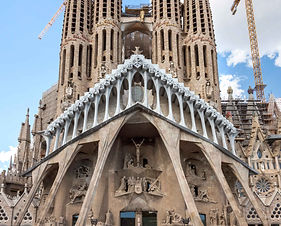
SAGRADA FAMILIA
The Basílica i Temple Expiatori de la Sagrada Família (Catalan pronunciation: [səˈɣɾaðə fəˈmiɫiə]; Spanish: Templo Expiatorio de la Sagrada Familia; English: Basilica and Expiatory Church of the Holy Family) is a large Roman Catholic church in Barcelona, designed by Catalan Spanish architect Antoni Gaudí (1852–1926). Gaudí's work on the building is part of a UNESCO World Heritage Site,[5] and in November 2010 Pope Benedict XVI consecrated and proclaimed it a minor basilica,[6][7][8] as distinct from a cathedral, which must be the seat of a bishop.
Construction of Sagrada Família commenced in 1882 by architect Francisco Paula de Villar with Gaudí becoming involved in 1883 after Francisco resigned as the head architect.[5] Taking over the project, Gaudí transformed it with his architectural and engineering style, combining Gothic and curvilinear Art Nouveau forms. Gaudí devoted his last years to the project, and at the time of his death at age 73 in 1926, less than a quarter of the project was complete.[9]
Sagrada Familia's construction progressed slowly, as it relied on private donations and was interrupted by the Spanish Civil War, only to resume intermittent progress in the 1950s. Construction passed the midpoint in 2010 with some of the project's greatest challenges remaining[9] and an anticipated completion date of 2026, the centenary of Gaudí's death.
The basílica has a long history of dividing the citizens of Barcelona: over the initial possibility it might compete with Barcelona's cathedral, over Gaudí's design itself,[10] over the possibility that work after Gaudí's death disregarded his design,[10] and the 2007 proposal to build an underground tunnel of Spain's high-speed rail link to France which could disturb its stability.[11] Describing Sagrada Família, art critic Rainer Zerbst said, "It is probably impossible to find a church building anything like it in the entire history of art"[12] and Paul Goldberger describes it as, "The most extraordinary personal interpretation of Gothic architecture since the Middle Ages."[13]
PARK GUELL
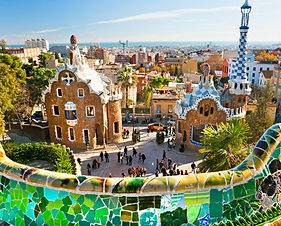
The Park Güell (Catalan: Parc Güell [ˈparɡ ˈɡweʎ]) is a public park system composed of gardens and architectonic elements located on Carmel Hill, in Barcelona, Catalonia (Spain). Carmel Hill belongs to the mountain range of Collserola – the Parc del Carmel is located on the northern face. Park Güell is located in La Salut, a neighborhood in the Gràcia district of Barcelona. With urbanization in mind, Eusebi Güell assigned the design of the park to Antoni Gaudí, a renowned architect and the face of Catalan modernism. The park was built between 1900 and 1914 and was officially opened as a public park in 1926. In 1984, UNESCO declared the park a World Heritage Site under “Works of Antoni Gaudí”.[1]
PLAZA CATALUNYA
Plaça de Catalunya (Catalan pronunciation: [ˈpɫasə ðə kətəˈɫuɲə], meaning in English "Catalonia Square"; sometimes referred to as Plaza de Cataluña, its Spanish name) is a large square in central Barcelona that is generally considered to be both its city centre and the place where the old city (see Barri Gòtic and Raval, in Ciutat Vella) and the 19th century-built Eixample meet.
Some of the city's most important streets and avenues meet at Plaça Catalunya: Passeig de Gràcia, Rambla de Catalunya, La Rambla or Portal de l'Àngel, in addition to Ronda de Sant Pere, Carrer de Vergara or Carrer de Pelai. The plaza occupies an area of about 50,000 square metres. It is especially known for its fountains and statues, its proximity to some of Barcelona's most popular attractions, and for the flocks of pigeons that gather in the centre.

TOURIST APARTMENTS; APARTMENTS FOR DAY; TOURIST ROOMS; STUDENT ROOMS ; VIP APARTMENT ; TRANSFER ; OFICIAL GUIES IN BARCELONA